Social Robotic Surveillance and Manipulation: New paper in THRI on robot risks to users and society
Read the ACM Transactions on Human-Robot Interaction (THRI) paper here.
This paper in THRI examines the potential harms to robot users and society, which could result from social robots surveilling and manipulating users at scale. We identify four potential harms: exploiting vulnerability, economic exploitation, harms to personal autonomy, and harms to democracy. h
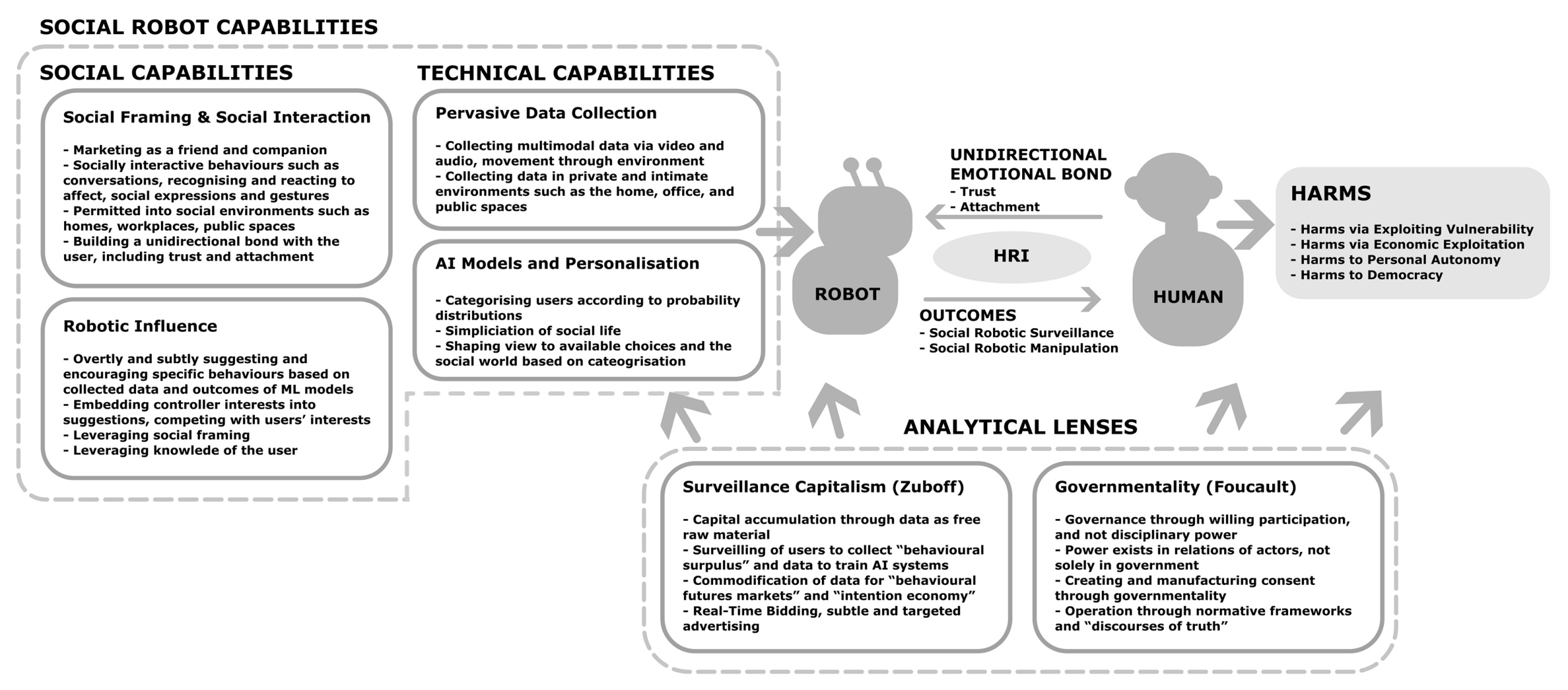
Framework for social robotic surveillance and manipulation, showing how social robot capabilities can lead to harms via unidirectional relationships towards robots, through the analytical lenses of surveillance capitalism and governmentality.
We argue that these harms could result from social robots utilising their unique capabilities. These capabilities include social capabilities such as social framing and social interaction, and robotic influence. These social capabilities are enhanced by technical capbilities, including pervasive data collection, and AI models and personalisation. Together, these capabilities can elicit a unidirectional emotional bond from a user, which in turn can have the outcomes of social robotic surveillance and manipulation. Viewed through the lenses of surveillance capitalism (as popularised by Zuboff) and governmentality (as proposed by Foucault), we identify the four potential harms to robot users and society: exploiting vulnerability, economic exploitation, harms to personal autonomy, and harms to democracy.